Ranking among the very top artists of contemporary jewelry
making internationally, Tone Vigeland has been a leading artist in her
native Norway for almost forty years. Pioneering a movement of goldsmiths
working in small private workshops hand making jewelry with an emphasis
on the free artistic expression, she started her own workshop in 1961.
She was followed by artists such as Gine Sommerfelt in 1964, Toril Bjorg
in 1968 and in the seventies by many others.
Upon graduating from the National College of Art and Design (NCAD),
Tone Vigeland got an apprenticeship at the metal workshop at PLUS (Fredrikstad,
Norway) from 1959 to -61. Tone Vigeland - in the company of Erling Christoffersen,
the leader of the workshop, and his wife Anna Greta Eker, were the most
prominent designers of PLUS jewelry. It soon got a repetition of being
simplistic modern jewelry, combining good form with sensitivity towards
the materials used. Tone Vigeland continued designing for PLUS also after
she started her own workshop.
In the 60s, Tone Vigeland was very obviously working in the Scandinavian
Design tradition. Some of her early works bear witness of a strong influence
from the Swedish artist Torun Bülow-Hübe who was working for
the Georg Jensen Company in Denmark. Key terms are simple geometric forms,
clean surfaces and solutions that are technically straightforward. Silver
jewelry was made with stones such as Carnelian, Jade and Amethyst. Long
chains and neck rings were made for pendants to be worn in everyday life.
Among the most distinct pieces are pairs of sculpturous swirl earrings
that cling elegantly to and around the ears.
Through her career Tone Vigeland has been represented in numerous exhibitions
and galleries. Amongst her earliest prestigious contributions were jewelry
for the Norwegian exibition at the XII Triennale in Milan 1960,
and Expo 67, the Montreal World's Fair in Canada.
Tone Vigeland eventually had a great international break through, exhibiting
in the London gallery 'Electrum' in 1981. This was followed by exhibitions
in New York, Tokyo and other major cities. Her career can be characterized
by a capability of continuously renewing artistic creativity, by a dialog
among contrasting forms, textures and materials, creating a daring expression.
In the 70s and 80s her emphasis moved in the direction of jewelry making
as fine art. She would apply e.g. hammered steel nails combined with gold
and small silver rings 'knitted' together to almost elastic constructions
making enormous necklaces, reminiscent of ritual objects from so called
primitive cultures.
An extensive book on Tone Vigeland - life and work, is available under
the 'books' menu on this web site.
|

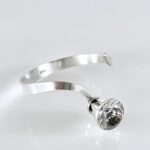
Ring, silver and glass, 1970s,
hand blown glassball by Benny Motzfeldt.

Tiara,
gold with Jade, 1966.

'Sling', earcuffs
silver, 1958.

Pendant,
silver with enamel, 1960s.

Ring,
iron and gold, 1981.

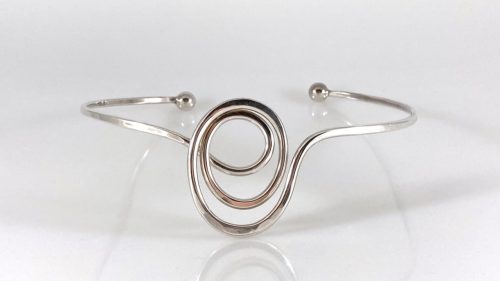
Collar, the 'Loop Series'
silver, 1960s.

Cufflinks 'Stripe',
silver with enamel, 1960s.
|